Cucumber
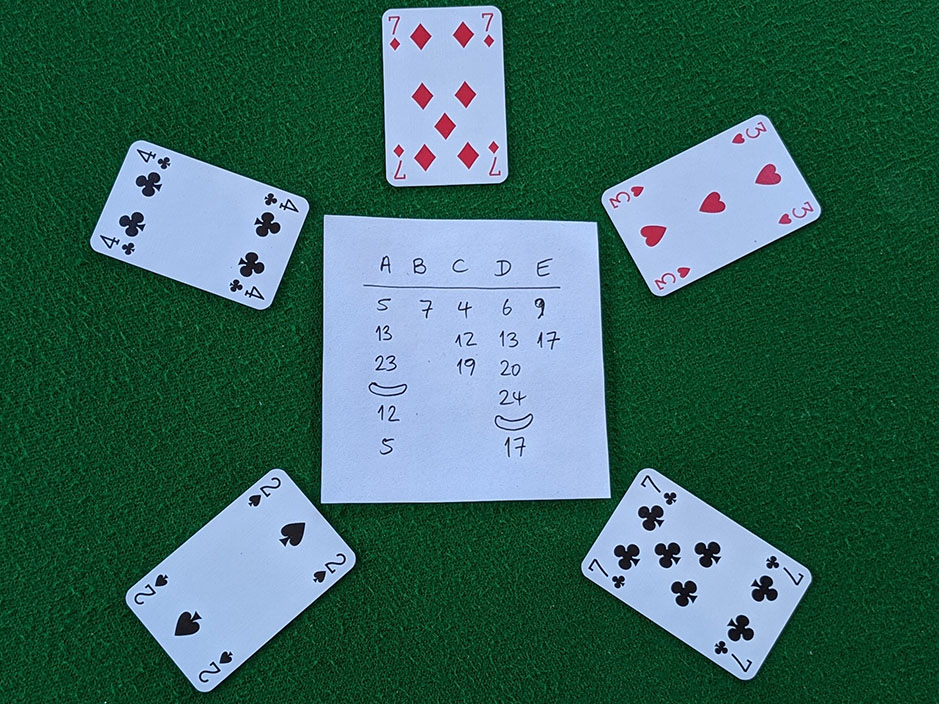
A Nordic game for up to 7 players in which the aim is not to win the last trick. When playing to a trick you must either overtake or play your lowest card.
Class: Lose last trick
Related games: Krypkille
- Introduction
- Agurk / 21 (the Danish game) - Procedure - Scoring - Strategy - Variants
- Gurka (the Swedish game)
- Ogórek (the Polish game)
- Kurkku / Mätäpesä / Rassi (the Finnish game)
- Gurka (the Norwegian game)
- Gúrka (the Icelandic game)
- Other Versions
Introduction
Cucumber is a kind of trick-taking game, in which the object is not to win the last trick. To make this more difficult, there is a rule that in each trick players must either overtake or sacrifice their lowest card. To be safe from losing, you therefore need not only a low card for the last trick, but also high cards for overtaking, so that your low card(s) do not have to be given up prematurely.
Cucumber appears to be a fairly recent game. It is played in several North European countries and was popular with students in the 1970's and 1980's. In the 1975 edition of the Swedish book Kortoxen by Einar Werner and Tore Sandgren, Gurka is described as "a comparatively new game". It does not appear in the 1949 edition, but was presumably introduced between these dates, since a translation is included as Kurkku in the 1970 Finnish book Pelataan korttia by Tore Sandgren. A very similar game Krypkille is played in Sweden with Kille cards. This game was already described in the 1949 edition of Werner and Sandgren's Kortoxen, and it seems likely that Cucumber originated as an adaptation of Krypkille to be played with the standard 52-card pack.
There are many somewhat different versions of Cucumber: the rules vary from country to country, and also within each country. This page describes forms played in Denmark (Agurk), Sweden (Gurka), Poland (Ogórek), Finland (Kurkku or Mätäpesä), Norway (Gurka) and Iceland (Gúrka). There are probably other versions, and variations described as played in any of these places may perhaps also be found in the others. The Danish game will be described in full, followed by the differences found in the other versions.
Agurk (Danish)
Agurk is the Danish word for cucumber; the game is also sometimes known as 21, since a player with more than 21 points loses. The game was played extensively at DIKU in the 1970s. The following description is based mainly on a contribution from Jens Brix Christiansen.
Procedure
Agurk is played with an ordinary deck of 52 cards. From 2 to 7 players participate. The cards are ranked from high to low A, K, Q, J, 10, 9, ..., 2; the suits have no significance. Cards are shuffled by the dealer and then dealt 7 at a time, face down, clockwise, starting with forehand (i.e., the player to the left of the dealer). The cards that are not dealt are set aside and seen by no one.
Seven tricks are played. The cards played are simply placed on the table face-up in front of each player; the cards are neither collected nor turned over after each trick. Any player may inspect any of the cards played to previous tricks. Forehand leads to the first trick; the winner of each trick leads to the next trick. Once a card is led, the remaining players each play a card to the trick in clockwise rotation.
The lead can be chosen freely. The other players in turn have a choice between:
- playing any card whose rank is at least as high as the highest card so far played to the trick, or
- playing their lowest ranking card.
The highest ranking card wins the trick; if there are several of these, the last of them to be played wins the trick.
The turn to deal passes clockwise after each hand. If the player whose turn it should be to deal has been eliminated from the game (see below), then the dealer is the next player in rotation who is still in the game.
Scoring
The player who wins the last trick loses the deal and is penalized. Each player's score is the running total of the penalties he has accumulated. The losing player on a deal receives as many penalty points as the rank of the card taking the last trick (A=14, K=13, Q=12, J=11, spot cards according the number of spots).
When a player's score reaches or exceeds 21, he loses a life; in the score, a cucumber is drawn to signify this. He is then reincarnated with the highest score that any other player currently has accumulated. The second time a player's score reaches or exceeds 21, he loses his life permanently and no longer participates in the game. Eventually, only two players remain; they continue to play until one of them loses his second life. The sole survivor is the winner of the game.
If any other players play in the last trick a card of the same rank as the card played by the loser of the deal, these other players are awarded a bonus of the same size as the penalty incurred by the loser. The bonus is deducted from the player's score. (Example: in the last trick of a six player game, the cards played are 5, 9, 3, 9, 9, 7, in that order. The fifth player wins the trick with the last 9 and gets 9 penalty points; the second and fourth players each have a bonus of 9 points subtracted from their scores).
Bonuses cannot lower a player's score below zero. For players on their second life, a bonus cannot lower their score below a cucumber and zero. Bonuses are deducted only after the loser's score is added. Thus in a two-person game where both players are at 18, and both players play a 10 to the last trick, the score for the loser is first changed to cucumber and 18, after which the bonus changes the other player's score to 8.
The winner goes on to deal the first deal of the next game.
Strategy
The best possible hand is four aces, two kings, and a low card. As forehand, you can lead your four aces, stripping all the other players of their four lowest cards, and continuing with your kings is bound to do significant damage. A hand of twos and threes is a boring hand, that will not engage its holder much. A hand of tens and jacks usually heralds catastrophe.
The simplest strategy is to try to survive each deal without taking the last trick. This is done by estimating at what level the last trick is likely to be taken and playing to get rid of cards at or above that level. To play this way is called to fimp. Fimping is an inferior strategy in the long run. Among seasoned players, "fimp" is a derogatory word. Even so, with inferior cards, fimping is the only available strategy.
If all players fimp, the rank of the last trick will be low, and the loser will incur an insignificant penalty. If, instead, the players with high cards (aces, kings, and with fewer than three players, maybe also queens and jacks) consistently lead their high cards, the unfortunate players without high cards will be forced to discard their low cards early in the game, thus raising the rank of the last trick. This is known as "playing sharp" (no connotation of dishonesty intended). In deals played sharp, a number of players form an alliance to ensure that someone is caught with a much higher card. The rationale behind this strategy is that when someone else is penalized, it should be as severely as possible. Playing sharp with good cards is a superior strategy in the long run; but you don't always hold good cards.
The game is often quite noisy. This means that alliances actually can be suggested orally during play. This includes bluffing, of course. It is not obvious whether the talking makes any difference to the actual play, since alliances are implicit anyway.
The two-person game, to which every game boils down, is quite different from the many-person game and surprisingly difficult to learn to play well.
The winning strategy in the long run is to play sharp almost always but to defect from an alliance of sharp players occasionally (when the cards are hopeless for sharp play). When played by experienced players, the game takes on many of the characteristics of the prisoner's dilemma.
Variants
Some players use a 55-card pack including three jokers. Jokers are then the highest cards, ranking above aces, and count as 15 points.
Some play that after the deal, the player to dealer's left (the first player) can discard a number of unwanted cards. He then draws an equal number of replacement cards from the top of the undealt part of the pack. Each of the other players in turn then has the option to discard the same number of cards as the first player and replenish their hands. You are not allowed to discard a different number of cards from the first player, but you may opt not to discard but to play with your original hand. If the first player does not discard, no one else is allowed to discard. If there are fewer cards remaining in the undealt pack than the first player exchanged, the next player must discard as many cards as remain in the pack or none at all. If the undealt cards run out, later players cannot discard at all.
Some players keep score by leaving the losing card of each hand face up on the table in front of the person who played it. There is no bonus for having a card equal to the losing card. A player whose cards add up to more than 21 drops out of the game - there is no second life.
Some play that if there is a tie for highest card at the end of a hand, all players holding those high cards lose that number of points, which may be indicated by keeping the cards in front of them, if you score that way.
Some play that the game ends as soon as any player goes over 21, and that player is the loser, rather than continuing until all but one player has been knocked out.
Some play that a player whose score reaches 21 points exactly has his score reset to zero (he puts all his scoring cards back in the pack).
Some play that instead of always dealing seven cards, from the second hand onwards the number of cards dealt to each player is the value of the losing card from the previous hand. So if a hand is lost with a jack, 11 cards each are dealt and 11 tricks played. If a two loses, players get only two cards each.
Gurka (Swedish)
Gurka is the Swedish word for cucumber. According to the earliest known account, in Werner and Sandgren's Kortoxen, the Swedish game Gurka was originally played in a rather similar way to the Danish game above.
A standard 52-card pack is used, ranking from ace (high) to two (low) and there can be from 3 to 8 players. At the start of the game everyone pays an equal stake into a pot, which is collected by the eventual winner. Six cards are dealt to each player, one at a time, clockwise. Play is clockwise, beginning with the player to dealer's left.
Any card may be led. Other players in turn must either play a card that is at least as high as the highest card so far played to the trick, or play their lowest card. The trick is won by the highest card played to it, and if several equally high cards are played, by the last of those.
Whoever has the highest card in the last trick scores that many penalty points (J=11, Q=12, K=13, A=14). If two or more players have equally high cards in the last trick they all score that number of penalty points. Any player who reaches a cumulative score of 30 points is out of the game: the player is said to be a cucumber, or to have flown. However, there is the option to buy back into the game for a second stake.
Each player has one opportunity to "buy in", provided that there are are at least three other players remaining in the game at the time. The player pays another stake to the pot (equal the original stake), and the player's score is reset to equal the highest score (most penalty points) of any of the other players who is still in the game. The normal time to buy in is just after you have been eliminated, but it might also make sense to buy in at some other time. For example if you lose the first two deals with a 10 and a jack and everyone else is still on zero, you could pay to have your score reset to zero. There is no obligation to buy in: if you reach 30 or more you can simply accept your defeat and leave the game. For example, if the other players' scores were 0-5-28-2 it would probably be unwise to buy in for a score of 28. You can only buy in once, if your score goes over 30 after you have bought in you are finally eliminated from the game until after the pot has been won.
This seems to have been the original version but there have been several significant changes in the rules. My thanks to Johan Pettersson and Dan Glimne for their help in collecting and analysing these changes.
- Only the previous player's card must be beaten
- The most important change is in the rules of play. In Sweden most, or possibly all players now use the rule that you must either beat or equal the previous player's card or play your lowest card. It is not necessary to beat the highest card in the trick. Example: the first player plays a king, the second player equals it with a king, the third player, having no ace or king, is forced to play his lowest card, a three. The fourth player having Q-7-2 is allowed to play the 7, because it beats the 3.
- My impression is that this rule might have arisen from a misunderstanding of the account in Kortoxen, in which the rules is ambiguously stated, and the intention that the highest card in the trick must be beaten is only clear if one studies the example of play that is provided. However, Hans-Olof Hallén of the Skånes Bridgefederation asserts that from the beginning the requirement was only to beat the immediately previous card.
- Must beat the previous card when possible
- Some play that each player must beat or equal the previous player's card if they can. Only a player who is unable to beat the previous card must play his or her lowest card. This rule is by no means universal. Many allow players the option to play their lowest card even when able to beat the previous card.
- Aces cannot beat aces
- A newer rule, now widely played, is that when an ace is played, the next player must play his or her lowest card. All other cards can be "beaten" by an equal card, but an ace cannot be played immediately after another ace to beat it.
- Lowest card must be led
- Some people now play that when leading to a trick you must play your lowest card.
- Target score and rebuys
- Some play to a score of 20 rather than 30. Some play with a fixed stake, and each player has one free rebuy.
Ogórek (Polish)
A distinctive feature of the Polish version of Cucumber, known as Ogórek, is that although the ace is the highest card during the first five tricks, in the last trick it becomes the lowest card, worth 1 point. This was the standard rule when I played in Warsaw in 1980, and the same rule was given in the Ogórek page of the Students Circle of Mathematicians at the Uniwersytet Jagielloński in Krakow, on which the following description is based.
The game is played with a 52-card pack, or more than one such deck if there are more than 8 players. Six cards are dealt to each player. The player to dealer's left leads any card to the first trick. Subsequent players in clockwise order must beat or equal the highest card in the trick if able to do so. Any player unable to equal or beat the highest card must play his or her lowest card. Whoever plays the highest card, or the last of equally high cards, leads to the next trick.
In the last trick, whoever plays the highest card receives penalty points according to the value of the card. In the last trick only, the ace is low and counts as 1 point. 2 to 10 are face value, J=11, Q=12, K=13. If several players have equally high cards, they all receive that number of penalty points. Players whose scores reach 50 points or more drop out of the game and the last surviving player is the winner.
Variations
The UJ maths students site lists the following variations, among others:
Classic Ogórek - played to 21 points rather than 50.
Ogórek with Kontra. After the deal the players speak in turn, beginning to dealer's left, saying either "pass" or "kontra". This continues until either someone says "kontra" or all have passed. If someone said kontra, the number of penalty points given to the loser(s) is doubled. If the player who said "kontra" loses, that player receives quadruple penalty points. If you say kontra and then lose with a king, you get a penalty of 52 (4×13) and lose the whole game in one hand.
Kurkku / Mätäpesä / Rassi (Finnish)
In Finland, versions of Cucumber are played under several names. The book Pelataan korttia by Tore Sandgren (1970) gives under the name Kurkku (Cucumber) a Finnish translation of the Swedish rules for Gurka as in Kortoxen , so it may be assumed that the games in Finland and Sweden were similar at this time. The same play example is given, so the implication is that players must either equal or beat the highest card in the trick or play their lowest.
Cristian Seres had similar rules on the Kurkku page of his Finnish card game website Korttipelien sääntöjä in a description contributed by Ohto Salo. There are a couple of differences: the number of players suggested is 3 or 4, not more, and it seems that the game ends as soon as any player reaches 30, with the player having the lowest score at that time declared the winner.
Pekka Ranta's book Marjapussissa Porvooseen (1993) includes a simple variant called Mätäpesä (Dirty Nest), which Anthony Smith has kindly translated. The number of players is not specified; they are dealt an equal number of cards from a standard 52-card pack. The implication seems to be that you should deal as many cards as possible - for example 7 each to 7 players - since the undealt cards are to be shown to the players after the deal. As usual the player to dealer's left leads to the first trick, and players must either equal or beat the highest card in the trick or play their lowest card. The highest card or the last of equally high cards wins the trick and the winner leads to the next trick. The winner of the last trick loses, and as a penalty must deal the next hand - the expression is "jaa kortit ja opi pelaaman" ("deal the cards and learn to play!"). No scoring system is given.
Another Kurkku variation is described on a web page by Antti Louko, under the name Kurko (King), which is somewhat confusing, since "King" is also the name of another card game. Kurko is played by 2 to 9 players with a 54- or 55-card pack including two or three jokers, from which six cards are dealt to each player. Players are forced to equal or beat the highest card in the trick if they can; only if they are unable to do this are they forced to play their lowest card. The jokers function exactly like aces, and as in the Polish game Ogórek the aces and jokers count as the highest cards in the first five tricks, but as the lowest cards, worth just 1 point, in the last trick. In this variant, players are not eliminated, but all carry on playing until all players but one have a score of 30 points or more. The game then ends with the player on the lowest score as the winner, and all other payers pay the winner in proportion to the difference between their scores.
On his web page, Cristian Seres includes a variation Rassi, contributed by Tuomo Väliaho. As I understand it "rassi" means cleaning, and according to Antti Louko's glossary it is the term for what happens when a player leads an ace, forcing everyone else to give up their lowest card.
- In Rassi, after dealing six cards to each player, the dealer asks "is it free?". Any players who have no picture cards (king, queen, jack) can at this point throw in their cards and receive a new six-card hand.
- Next the dealer asks for "doubles?", at which point any player may discard all six cards and receive a new hand of six cards. Any player who has taken advantage of the opportunity to "double" will suffer a double penalty if he or she has the highest card on the last trick.
- After any double, the dealer offers the player the chance to "redouble" - to discard all six cards again and receive another new hand. A player who loses after redoubling loses four times the usual number of penalty points.
- It is possible for a player who begins with no pictures in hand to exchange cards three times, for "free", "double" and "redouble".
- In this game, aces are high in the first five tricks, but low, counting 1 point, in the last trick. A player whose score reaches 50 is eliminated and the last surviving player wins.
Gurka (Norwegian)
Norwegian Gurka is very similar to the Danish game. It is played with 52 cards and 7 cards dealt to each person. According to a post on the skillsrinet forum there are a few differences:
- A player who reaches 21 points is immediately eliminated from the game - there is no second life.
- There is no bonus for playing a card equal to the loser's card in the last trick.
- Jokers can be added to the deck, in which case they function as extra aces.
- Alternatively, some play that an ace cannot be played on an ace. Since aces may then be played on four separate tricks, this results in a tenser game where the losing card may be quite high.
Nick Vidargas has described a variant that he learned under the name Norwegian, so it may well correspond to another version of Gurka played in Norway. The differences from the above game are as follows:
- In the first hand, 5 cards each are dealt. Subsequently the number of cards dealt is equal to the value of the card held by the loser of the previous hand, with a maximum deal of 7 cards each.
- As in some Danish variants, the dealer may discard some cards, keeping at least two, and draw replacements. If the dealer does this, each of the other players has the option to exchange the same number of cards as the dealer or play with their original hand.
- The dealer plays first, and the player of the lowest card in the last trick, and the first of these if several are equally low, deals the next hand.
- When counting the loser's score all pictures and aces count as 11.
Gúrka (Icelandic)
An Icelandic version of Cucumber is described at spilareglur.is (archive copy) and Anthony Smith has kindly provided a translation. This version is unusual in that it is possible to lead several cards at the same time, and that the  6 is the highest card.
From 2-4 players play with a 52-card pack in which the cards rank from Ace (high) down to Two (low) as usual, except for the six of clubs, which is higher than all other cards including aces. In the first hand, 10 cards are dealt to each player, in the second hand 9 cards, and so on, reducing the hand size by one in each new deal.
The player to the left of the dealer begins and may lead a single card or any number of equal cards - for example two eights or three jacks. If a single card is led, the rule is the same as in Denmark and elsewhere: subsequent players must beat or equal the highest card in the trick or play their lowest card. If more than one card is led, subsequent players must each player an equal number of cards. These cards need not be equal to each other, but they must be at least as high as the highest set of cards so far played to the trick, or the lowest cards that the player has. For example if 5-5-5 is led, the next player might play 5-9-J, on which the following player could play 8-Q-K. The fourth player, holding for example 2, 2, 4, 7, 7, J, J, A cannot play higher or equal; having used the ace to beat the king there is no other card in the hand that is as good as the queen. Therefore this player would be forced to play 2-2-4.
The trick is won by the player of the highest card or set, or by the last of equally high cards or sets, and the winner leads to the next trick. Players must keep a single card for the last trick. Even if your last cards are equal - for example a pair of 4's - you cannot lead them both at once. The winner of the final single card trick scores a penalty equal to the value of that card (Ace=14, King=13, Queen=12, Jack=11, 10-2 face value). This is indicated by storing the losing card in front of the player while the remaining cards are shuffled for the next deal. There is no bonus for having a card equal to the losing card. The 6 has a value of 21 points.
A player who has a total score of more than 21 (as indicated by the sum of the cards in front of the player) drops out of the game, while the remaining players continue playing. The last surviving player is the winner.
A player who has a score of exactly 21 points returns to zero and remains in the game. The player's scoring cards are shuffled back into the pack.
Note that a player who has the 6 as the last card will lose the hand since this is the highest card in the pack. If the player has previously lost a hand, this will take the player's score over 21 and the player is eliminated from the game. On the other hand if the player has no previous scoring cards, the 6 creates a score of 21 which becomes 0 and the player stays in the game.
Variants
Some play that before leading to the first trick, the player to dealer's left may discard some cards and draw an equal number of replacements from the undealt cards. In that case each other player has the opportunity to discard and draw before the play begins, with the restriction that the number of cards discarded must be less than or equal to the number discarded by the first player.
Some play with the two black sevens as equal high cards, in which case the six of clubs is just an ordinary six. In one version the  7 is highest, counting 16 points and the 7 is second highest, counting 15 points. In another, the two black sevens are equal highest, counting 21 points each.
Some play with the Swedish rule that it is only necessary to beat the previous card, not the highest card in the trick.
Some play with just 5 cards dealt to each player throughout. Some play with a different sequence of deals: first 6 cards each, then reducing one card at a time to 1, then increasing to 5, reducing to 1, increasing to 4, reducing to 1, etc. The result of a 1-card deal is of course pure chance.
Other Versions
There is an American variant twenty-two, which is quite similar to Icelandic Cucumber except that the six of clubs is not a special card. This is described on a separate page.
Gwenael Beuchet describes Concombre, a version developed in 2009 and played at the Playing-Card Museum at Issy near Paris. The winner of the last trick keeps the card that won the trick face up in front of them, and this determines the number of cards to be dealt to each player in the next deal (Jack=11, Queen=12, King=13, Ace=14). If there are not enough cards to go around, the players are dealt 7 cards each. Each player's score is the total value of the cards face up in front of them. When a player reaches a score of 21 or more they are given a 'half-cucumber' and they give back to the dealer all their face-up cards except the highest, which determines the number of cards dealt in the next deal. When a player reaches 21 or more for the second time the game ends and this player is the loser.
Barry Rigal has described some variants played at the 2004 European Junior Bridge Championship in Prague. Since this was an international event, these probably reflect the practice in various countries. Some played with the variant described in the Swedish section above in which an ace forces the next player to play their lowest card. Some allowed players to choose whether to beat or equal the highest (or previous) card or to play their lowest card; others played by the rule that one must equal or beat the highest card if one can. Some played that one must play the lowest card one has that equals or beats the previous card, and holding no such card play one's lowest card: this removes all choice from the players except the decision of which card to lead to a trick. Some played that all players holding the highest card in the last trick score that number as a penalty; others that only the last of those players took a penalty.
Friedeman Friese has designed a variant known as Five Cucumbers, played with a special 60-card deck.
Bernard Dulac has invented a variant Minibluff that incorporates Backgammon-style doubling. It can be played online at minibluff.com.